

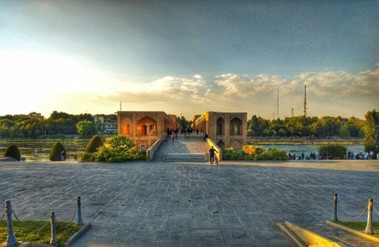
In this blog post we will use the city of Isfahan as a base to explore Safavid art and architectural styles, centering on the famous Naqsh-e Jahān square and the various buildings which surround it. We will also discuss the importance and legacy of the Safavid dynasty, particularly with regards to Shāh Abbās’ reign.
The last three blog posts in this series have been focused on ancient and medieval Persian history, namely the Achaemenid Empire, the Ilkhanid dynasty, and the Timurid dynasty. This fourth instalment about Isfahan city and the Safavids is especially exciting as it brings us towards the beginnings of the modern Iranian period. The Safavid dynasty (1501-1739 AD) can be thought of as the start of a modern Iran for several reasons, such as the establishment of Twelver Shi’a Islam as the state religion, the regaining of territory which was previously lost to the Uzbeks and Ottomans, and a strengthening of Iran’s diplomatic relations and export economy.
The Safavid period is regarded as a high point for Persian art and architecture, especially for its Persian miniature paintings, carpet weaving, manuscript illumination, glasswork, and ceramics. Nowhere is this artistic refinement better portrayed than in Isfahan’s Maydān-e Naqsh-e Jahān [‘Image of the World Square’] and its surrounds. The Naqsh-e Jahān square acts as the quintessence of Safavid art and architecture, so it is for this reason that we are focusing our fourth blog post on Isfahan city.
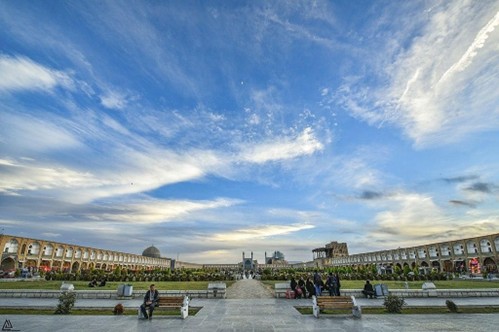
Image of the Naqsh-e Jahān square courtesy of Ahmad Jamāli Moqaddam,
accessed via Wikimedia Commons, 2018.
The person responsible more than anybody else for the Safavid dynasty’s long-lasting legacy upon Persian culture is undoubtably شاه عباس بزرگ Shāh Abbās the Great. He was born in 1571 AD in Herāt, the then capital of the Khorāsān region. He became the 5th ruler of the Safavid dynasty, taking over from his father محمد خدابنده Mohammad Khodābande. Khodābande’s time as ruler was plagued with factionalism and unrest, so much so that his queen, Kheyr an-Nesā’ Bigom, as well as his eldest son, were murdered by Qezelbāsh tribes[1]. The Ottoman empire in the west took advantage of Khodābande’s weak rule to take control of Tabriz in 1585 AD. To the east, Uzbek armies were also beseiging cities in Khorāsān such as Herāt and Mashhad. It was clear that King Mohammad Khodābande, who according to historical sources was also blind, needed to be replaced by someone more strong-willed. A coup was staged to overthrow him, and it seems that Khodābande made no attempt to stop it.
Despite it being the Qezelbāsh tribes who successfully staged the coup to bring him to power in 1588 AD, Shāh Abbās had not forgotten that it was those very same Qezelbāsh who had strangled his mother to death a few years prior. His first priority as new ruler of the Safavids was to avenge his mother’s death. He did this by executing or exiling the individuals responsible for queen Bigom’s death, and over time he started to weaken the Qezelbāsh’s military leverage. Then he began the more difficult task of rebuilding an Iran that had been crippled by political termoil and territorial losses.
The years between 1590 and 1610 AD saw Shāh Abbās initiate a lot of favourable change in Iran. His main goals appeared to be to promote commerce and trade, and to centralise government. In 1598 AD he successfully recaptured Khorāsān (the north east of Iran) from the Uzbeks, and in 1602 AD he recaptured lost territory from the Ottomans to the west. He took control of the Hormuz Straight from the Portuguese, and began improving trading infrastructure by building new roads and caravanserais.

Portrait of Shāh Abbās the Great painted by an unknown Italian painter,
accessed from Wikimedia Commons (public domain).
In the year 1598 AD, Shāh Abbās moved the Safavid capital from Qazvin in the north west, to Isfahan in the centre of the country. Isfahan was already the most populous city on the Iranian plateau at this time, and was located in a geographically strategic location at the ‘heart of Iran’. Isfahan was at a trade route crossroads with easy links to the Persian Gulf in the south east, and with roads leading to other important craft cities such as Kashan, Shiraz and Yazd.
It is clear that Shāh Abbās had a bold vision for redeveloping Isfahan and that he was personally involved in many elements of the city’s urban design and new construction projects. He wanted to turn Isfahan into an exquisite multicultural metropolis, complete with gardens, large civic spaces, new neighbourhoods, and especially an incorporation of commerce into public spaces. He wanted both residents and visitors to Isfahan to be active rather than passive participants in the urban landscape, for example through utilising the city’s markets, coffehouses, gardens, plazas, and avenues for strolling.
There is a popular rhyming phrase used in Persian which pertains to the city of Isfahan:
اصفھان، نِصفِ جھان Esfahān, nesf-e jahān
‘Isfahan, half the world’
It is up for debate exactly where this phrase originated, and how much historical significance it holds. Some believe its origin stems from the fact that Isfahan, especially during Safavid times, had a reputation for being a melting-pot city, home to a diverse mixture of artisans and merchants from all over Iran and from even further afield. This is evidenced by the multiethnic urban layout of Safavid Isfahan, such as the New Jolfā neighbourhood which was built to house the Armenian Christian community, and the Jewish Juybāre neighbourhood which is believed to be the oldest part of the city, settled by an exiled Jewish community during the Sassanid period.
Others believe that the phrase holds a more cosmic significance. The 11th century Persian polymath Biruni, who was in turn influenced by the Ancient Greek mathematician Ptolemy, divided the world into seven different portions, roughly equivalent to what we would call longitudes today. These geographic segments were known as the ھفت اقلیم haft eqlim or the ھفت کشور haft keshvar. The 4th segment was centered on ایران زمین irān-zamin [‘The Iranian Land’], of which Isfahan sits directly in the centre. Therefore due to Isfahan’s location at the midpoint of the 4th geographic segment, the city can be thought of as being located at roughly the halfway point of the mapped medieval world.
It is fitting then that the large public square commissioned by Shāh Abbās is known today as the ‘Image of the World Square’, in keeping with its supposed geographical and cosmological importance. The Naqsh-e Jahān square measures 512 by 159 meters, making it the largest public square in Iran and one of the largest in the world. The square and the buildings surrounding it are all registered as a UNESCO World Heritage Site. The centre of the square was left empty and filled with sand for use for a variety of purposes, including for polo, public spectacles, parades, executions, and festivals. The square is enclosed by an arcade of shops, each of which contains an upper level balcony which was used as lodging for merchants, or as a viewing gallery for spectacles.
The Safavid historian Natanzi provides us with an interesting account of one of the spectacles held in the square in the year 1596 AD. He writes that people crowded on to the upper balconies of the arcade to watch and that the walls and balconies of the arcade were decorated with colourful textiles and carpets. In the centre of the square, four artificial gardens were constructed, complete with wooden trees, fabric flowers, and wax fruits. In each garden there was a miniature castle filled with puppet soldiers. Then a mock battle was enacted between the Safavid and the Uzbek armies, and of course the Safavid puppet army was victorious (this spectacle was staged only two years following the Safavids’ recapturing of Khorāsān from the Uzbeks). Fireworks were set off, cannons were fired, and the four miniature castles were set ablaze to create a grand pyrotechnic finale.
Running next to the balconied arcades there was a water channel and a pedestrian walkway, with trees planted at regular intervals in line with the arches of the arcade. The design of the square therefore highlights the importance of nature as a design element in Safavid architecture, with the trees and the water channel serving to demarcate the different domains of use of the civic space. We see here the importance placed on bringing natural elements into the design so that visitors to the space feel like they are interacting with both the urban and the natural world. The fact that the Naqsh-e Jahān square is completely surrounded by an arcade of shops also reminds us that increasing commercial activity was one of the main justifications for Shāh Abbās’ development of the square.
On each side of the square there is a monumental façade or entrance way which leads on to another important Safavid building complex:
Located on the north side of the square, one can find the سردر قیصریه sardar-e qeysariye [‘Qeysariye Gate’] which leads to the Grand Bazaar of Isfahan.
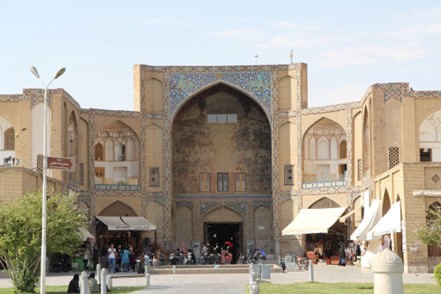
Image of the Qeysariye Gate courtesy of Professor Theodore van Loan. In his book Mirrors of the Unseen, Jason Elliot gives this lively description of Isfahan’s bazaar: ‘It is hard to think of any urban structure which gives as much pleasure to explore. Walking along its vaulted tunnels is like being carried along by a complex and harmonious piece of music. The drone activity is constant, but overlaid by the enclosing architecture into rhythmic, lyrical, and sometimes monumental themes’ (p.62).
On the south side of the square, we have a grand entrance leading to the مسجد شاه masjed-e shāh [‘the Royal Mosque’].
The east side of the square is home to an intricately designed entrance way which leads to the مسجد شیخ لطف ﷲ masjed-e sheykh lotfollāh [‘the Sheikh Lotfollah Mosque’]. This was a private mosque used for the royal family and court.
Finally, on the west side we have the Ali Qapu gate, the palace-gate which leads from the main square into the دولت خانه dowlat-khāne [‘Govermental Palace Complex’] . The fact that the government palace complex is situated directly across from the Sheikh Lotfollah Mosque serves to remind Shāh Abbās’ subjects of the deepening tie between Safavid rule and Shi’a Islam.
The two mosques located on the Naqsh-e Jahān square deserve a more detailed description of their own. The مسجد شاه masjed-e shāh [‘the Royal Mosque’] is considered by some to be the grandest and most famous of all the Safavid monuments, and was the last major building project to be added to the square. The Royal Mosque was clearly inspired by Timurid-era congregational mosques, especially by the
Bibi Khānom mosque in Samarqand. Its vast turquoise dome can be seen from all over the city; the Royal Mosque ‘monumentalized the cityscape, endowing the new Isfahan with a majestic profile commensurate with its newly acquired status as the metropolitan capital of a reinvigorated Safavid empire’ (Farshid Emami, p.48).
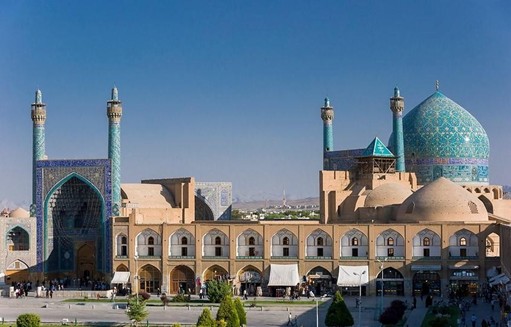
The epic scale of the Royal Mosque’s dome, despite Byron calling it a ‘huge blue bulk’ in his 1937 book The Road to Oxiana, served to give Isfahan a new silhouetted skyline. The dome created a distinct Safavid dynastic signature for the cityscape, comparable to the effect of the Süleymaniye Mosque’s silhouette upon Ottoman Istanbul’s skyline. Image copyright of Idries Trevathan, from his book Colour, Light and Wonder in Islamic Art, republished in The Dispatch on March 29th 2020.
The grand entrance portal leading to the mosque courtyard area is 27 metres high and capped with a large muqarnas arch and two slender turquoise minarets. Every available surface of this entrance way is covered in shimmering turquoise tiles and white thuluth-style calligraphic inscriptions.
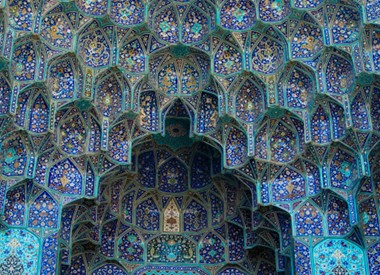
Image of muqarnas vaulting from the Royal Mosque’s entrance portal,
courtesy of Sina Bahar, via Unsplash, 2022.
The passage which takes visitors from the entrance portal on the Naqsh-e Jahān square into the inner mosque area is set off at a 45 degree angle. This is because the Naqsh-e Jahān square does not align with Mecca, so it was necessary for the Royal Mosque to be built slightly offset from the main square in order to align to the قبله qeble [‘direction facing Mecca for prayer’]. This misalignment has the unexpected benefit of allowing the dome of the Royal Mosque to be visible from everywhere around the square, no matter at what angle you are facing. In his book Mirrors of the Unseen, Jason Elliot argues that this shift in axis serves a deeper spiritual purpose: ‘the reorientation affirms an inner shift as well, from the domain of worldly things towards a place of tranquility and abundance’ (p.67).
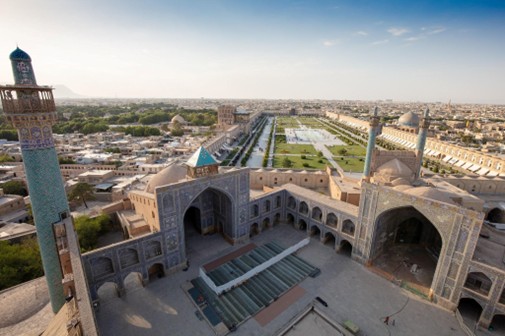
From an aerial view the shift in axis is clearly visible. Image copyright of Idries Trevathan, from his book Colour, Light and Wonder in Islamic Art, republished in The Dispatch on March 29th 2020.
The Royal Mosque is home to some of the most impressive tilework in the world. Some of the tiles were replaced in the 1930s, but most of the tilework remains unchanged since the 1630s. Every interior and exterior surface of the mosque is covered in colourful polychrome tiles, giving the walls an almost fluid or liquid effect. When viewed up-close, the aesthetic beauty of each individual tile can be appreciated. When viewed from a distance, the tilework transforms into a shimmering reflective surface, similar to silk.
The style of tilework at the Royal Mosque is known as haft rang [‘seven colours’]. This is a style of tiling that became popular in the Safavid era, and was continued to be used well into the Qajar era. Haft rang tilework is produced by drawing intricate designs onto square tiles, applying different coloured glazes directly onto these tiles, and then firing the different coloured glazes together. It can be thought of as a ceramic colour-by-numbers. The name haft rang [‘seven colours’] does not mean that every tile has to have seven different glazes painted onto it; this tiling method is so named because seven is the traditional limit to the amount of different colours possible to paint onto one tile. Painting directly onto the tiles is much faster and more cost effective when compared with the older tilework method known as mo’araq. Mo’araq tilework involved glazing and firing each colour individually and then cutting up the tiles into tiny shards to create intricate mosaic patterns.
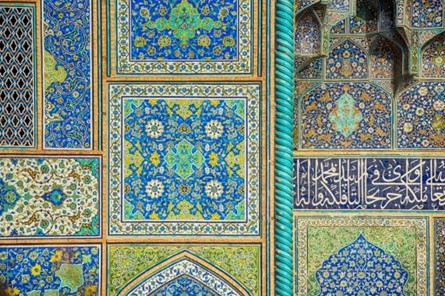
Image of haft rang tilework from the Royal Mosque in Isfahan, courtesy of Saeid Shakouri
(https://saeidshakouri.com/kheshti-or-haftrang-tile-in-iranian-architecture/)
The much smaller مسجد شیخ لطف ﷲ masjed-e sheykh lotfollāh [‘Sheikh Lotfollah Mosque’] is located on the east side of the square. This mosque was named in honour of Shāh Abbās’ father-in-law, Sheikh Lotfollāh Maysi al-’Amili. In terms of its design, this mosque is more similar to a large mausoleum than to a traditional mosque. For example, the mosque does not have any minarets, no courtyard space, and is comprised of a single domed chamber with a few smaller rooms attached. This is because the Sheikh Lotfollah Mosque was designed to be a private mosque for use only by the royal court.
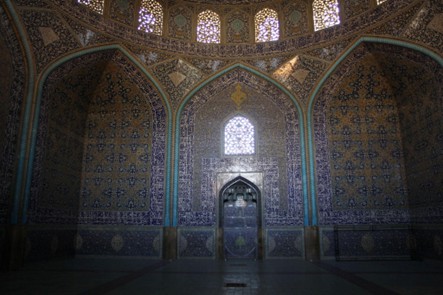
Image of the interior of the Sheikh Lotfollāh Mosque courtesy of Professor Theodore van Loan.
Although it is smaller and simpler in design than the Royal Mosque, it is arguably more intricate in its design. For this reason it can be called the jewel of Safavid architecture. The sophistication and beauty of the Sheikh Lotfollah Mosque’s ornamentation cannot be better described than by Robert Byron in his travel memoir The Road to Oxiania, (pp.?):
‘I know of no finer example of the Persian Islamic genius than the interior of the dome: The dome is inset with a network of lemon-shaped compartments, which decrease in size as they ascend towards the formalised peacock at the apex… The mihrāb in the west wall is enamelled with tiny flowers on a deep blue meadow. Each part of the design, each plane, each repetition, each separate branch or blossom has its own somber beauty. But the beauty of the whole comes as you move. Again, the highlights are broken by the play of glazed and unglazed surfaces; so that with every step they rearrange themselves in countless shining patterns… I have never encountered splendor of this kind before.’
The interior design of this mosque is so famous that numerous carpet patterns have been inspired by it, most notably the world’s second largest carpet, ‘The Carpet of Wonder’ in Oman, as well as the Ardabil Carpet located in London’s Victoria & Albert Museum.
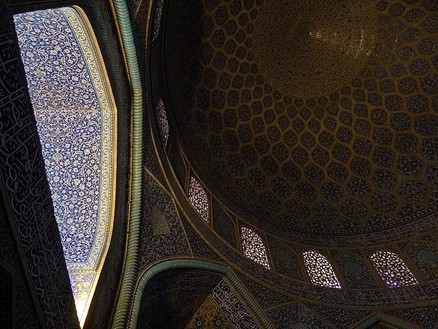
Interior detail of the Sheikh Lotfollah Mosque – in the centre of the dome the viewer can see the golden rays of light fanning out to form the shape of a peacock’s tail. Image courtesy of Adam Jones, via Wikimedia Commons, 2012.
Located directly to the west of the Naqsh-e Jahān square, through its west gate, leads us to the دولت خانه dowlat-khāne [‘Governmental Palace Complex’]. This area housed the shāh’s royal pavilions and gardens, both for his private use and for official receptions and entertaining guests.
The western gate leading to the dowlat-khāne, called the کاخ علی قاپو kākh-e ali-qāpu [‘Ali Qapu palace’], is a spectacle of Safavid architectural design and aesthetic in and of itself. It was built into the western arcade of the square, and added to in stages. By its completion, the Ali Qapu palace was composed of 6 floors, each floor uniquely decorated and painted. The third floor of the palace contains a large semi-outdoor patio space, supported by 18 tall columns, each one decorated with mirrors and paintings. In the centre of the patio space there is a large marble pool. The third floor, as well as the top floor, were used for official court receptions and music events.
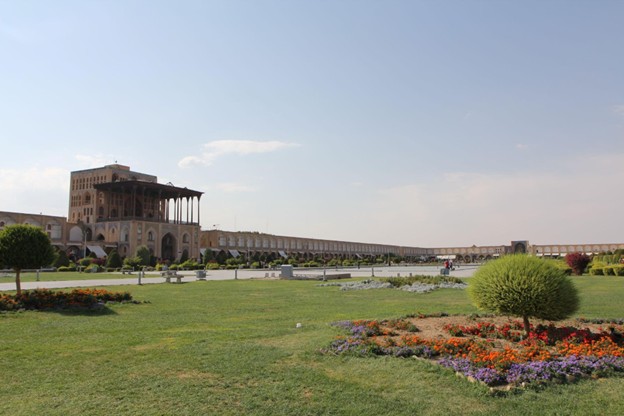
Image of the کاخ علیقاپو kākh-e ali-qāpu visible from the centre of the maydān,
courtesy of Professor Theodore van Loan.
Another famous royal pavilion located inside the dowlat-khāne is the کاخ چھل ستون kākh-e chehel sotun [‘Fourty Columns palace’]. This pavilion was used for entertainment and royal receptions. The main hall of the chehel sotun pavilion is two stories high and designed around a large veranda with 20 columns. This columned veranda is reminiscent of an Achaemenid hypostyle hall. When these 20 columns are reflected in the long pool located in front of the pavilion, their reflection creates the illusion of 40 columns, hence the palace’s name of chehel sotun [‘fourty columns’]. Inside the main hall there are large frescos on the walls depicting famous Safavid battles as well as receptions hosted by Shāh Abbās. If Queen Elizabeth I’s royal visit to Isfahan had gone ahead as planned, she would have been housed in the chehel sotun palace.
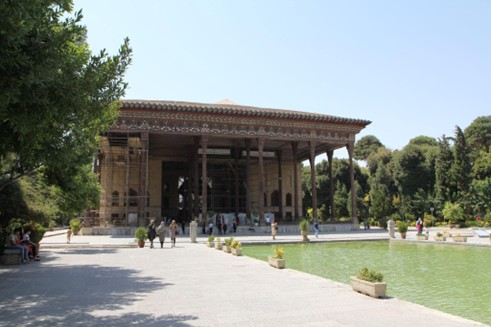
Image of the چھل سُتون Chehel Sotun [‘Fourty Columns’] palace
courtesy of Professor Theodore van Loan.
4. Bridges and avenues پُل ھای معروف اصفھان و چھارباغ
A description of Safavid Isfahan wouldn’t be complete without a passing mention of the پُل خواجو pol-e khāju [‘Khāju Bridge’], سی و سھ پُل si-o-se-pol [‘Thirty three arch bridge’], and the خیابان چھارباغ khiyābān-e chahārbāgh [‘Four Gardens Avenue’].
The خیابان چھارباغ khiyābān-e chahārbāgh [‘Four Gardens Avenue’] is the main North-South boulevard of Isfahan, built in 1596 AD. Shāh Abbās’ original design for the avenue included water channels, gardens, and walkways for strolling, with many pavilions, coffeehouses, government buildings, and Sufi convents lining its sides. In the modern day, however, much of the original design has been surrendered for use by cars, and the chahārbāgh has certainly lost some of its tranquility of centuries past. During Safavid times, on Wednesdays the chahārbāgh was open only to women, intended to provide a secluded place for the women in the city to relax freely.
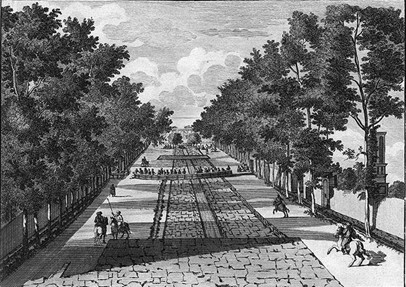
Drawing of the Chaharbagh in 1705 by Dutch artist Cornelis de Bruijn, courtesy of Wikimedia Commons (public domain).
The chahārbāgh boulevard crosses the Zāyande River at the سی و سه پُل si-o-se-pol [‘Thirty three arch bridge’], before continuing south to the Armenian Jolfā neighbourhood. The si-o-se-pol is the largest of the historic bridges that cross the Zāyande and has become a famous symbol of Isfahan city. This bridge is officially called the Allahverdi Khān Bridge, in honour of the Iranian-Georgian general who oversaw the construction of the bridge, and was a close friend of Shāh Abbās.
Image of the si-o-se bridge courtesy of Reza Ghasemi, via Unsplash, 2020.
The most exquisite bridge to cross the Zāyande River is perhaps the پُل خواجو pol-e khāju [‘Khāju Bridge’]. It was designed to not just be a bridge, but also as a place for public meetings and recreation. This again shows us how much importance Shāh Abbās seemed to place on creating public spaces for strolling and interacting with the city itself. The bridge is decorated with tilework and paintings, and also functions as a weir. In the middle of the bridge Shāh Abbās had a small pavilion constructed, from where he could admire the view along the river.
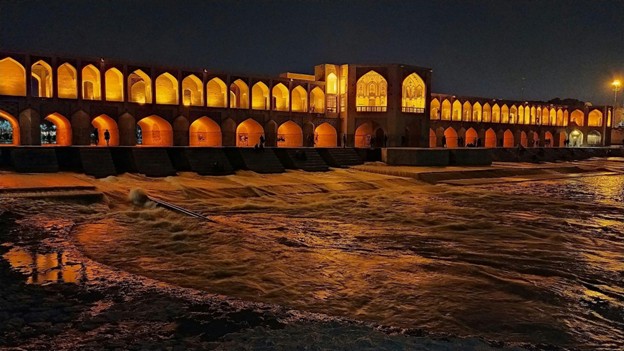
Image of the Khāju Bridge courtesy of Mohammad Nasr, via Unsplash, 2020.
It can be tricky to pin down a specific set of components that make up a uniform سبک صفوی sabk-e safavi [‘Safavid style’]. Each building or monument we have looked at in this blog post seems to differ in terms of its style and design.
It is clear that during Safavid times there was a focus on decorative elements, which caused an increase and refinement in tilework production. Seemingly any surface could be covered with intricate tilework. Tile designs could be moved around or placed upon different surfaces with very little change. This is in contrast to earlier Ilkhanid or Timurid architectural styles where the decorative elements of the design were more integral to the building’s structure, such as the Ilkhanid double dome design.
So apart from extensive tile decoration, how can we define a unique Safavid style? Safavid Isfahan has less of an underlying or over-arching architectural theme when compared to a city like Timurid-era Samarqand. However, it should be clear by this point in the blog that Shāh Abbās’ real focus was on large-scale urban planning and Isfahan’s city layout as a whole. The true spectacle of Isfahan’s design lies in its layout, where commercial, recreational, religious, and royal spaces are built into the city’s urban fabric. What made Safavid Isfahan so special was that the city was viewed as something alive or organic that needed to be interacted with and explored. Shāh Abbās clearly had a passion for urban planning and took immense pleasure from (re)designing Isfahan. Even in modern times his legacy has not been lost, as a modern-day visitor to Isfahan can still feel this sense that the shāh wants people to enjoy strolling around his city.
Farshid Emami, Isfahan – Architecture and Urban Experience in Early Modern Iran, 2024.
Oleg Grabar, Isfahan as a Mirror of Persian Architecture, 2006.
Jason Elliot, Mirrors of the Unseen, 2006.
Robert Byron, The Road to Oxiana, 1937.
Special thanks to Professor Theodore van Loan for providing some wonderful photos and other useful reading materials!
[1] Who were the قزلباش Qezelbāsh/Kızılbaş [‘Red Caps’]? The Qezelbāsh were a collection of different Shi’a Turkmen tribes who supported the Safavid dynasty. They wore red caps, hence their name, to show allegiance to the Safavids. They became an integral part of the first Safavid army, but by the end of Shāh Abbās’ reign they had gradually lost their military importance.
– Sam Styan


